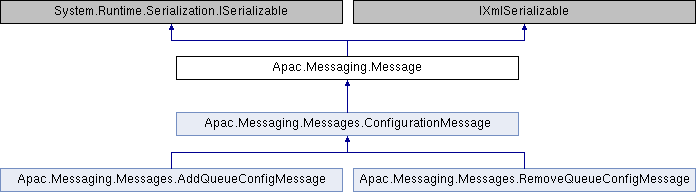
This class provides the data structure for both outgoing (queued) and archived messages.
More...
|
| | Message (string queue, MessageType type, string subject, string body, string initiatingProcess, string initiatingUser) |
| | Creates a new message instance. More...
|
| |
| | Message () |
| | Parameterless constructor provided for XML serialization. More...
|
| |
| void | AddProperty (string propertyName, object data) |
| | Puts an object in the property bag, which is the extended data for the message, apart from the message content. This data is stored with the message but is not delivered along with it. It can be used to drive any special handling required for the message, but standard handlers ignore it. More...
|
| |
| object | GetProperty (string propertyName) |
| | Dips into the property bag and returns the extended data with the given name. More...
|
| |
| List< DeliveryStatus > | GetHistoryByProtocol (MessagingProtocols protocol) |
| | Gets sublist of delivery status messages that match the requested protocol sorted by timestamp (ascending). More...
|
| |
| void | GetObjectData (SerializationInfo info, StreamingContext context) |
| | The serializing method for binary data. More...
|
| |
| System.Xml.Schema.XmlSchema | GetSchema () |
| | This method is a no-op. We have opted to use the System.Xml.Serialization.XmlSchemaProviderAttribute instead. More...
|
| |
| void | ReadXml (System.Xml.XmlReader reader) |
| | Deserializes object data from XML format. More...
|
| |
| void | WriteXml (System.Xml.XmlWriter writer) |
| | Serializes object data to XML format. More...
|
| |
|
| | Message (SerializationInfo info, StreamingContext context) |
| | Deserializes a message from binary format. More...
|
| |
| virtual void | OnReadXml (System.Xml.XmlReader reader) |
| | The virtual plug-in point for XML deserialization, for subclasses to participate. More...
|
| |
| virtual void | OnWriteXml (System.Xml.XmlWriter writer) |
| | The virtual plug-in point for XML serialization, for subclasses to participate. More...
|
| |
|
| Guid | Id [get] |
| | Gets the auto-generated unique ID for this message. More...
|
| |
| string | Queue [get, protected set] |
| | Gets the designated queue for the message. This provides scope isolation within the messaging system and can be used to securely partition storage space between different security contexts (eg: two banks using the same server can have their messages segregated by queue, each with its own exclusive permissions). More...
|
| |
| MessageType | Type [get, protected set] |
| | The category to which this message belongs. This provides message routing within the message handling control structures. See MessageType for details about each type. More...
|
| |
| string | Subject [get, protected set] |
| | Gets the brief summary or topic for the message. More...
|
| |
| string | Body [get, protected set] |
| | Gets the content of the message. More...
|
| |
| string | BodyAsHTML [get] |
| | Gets the content of the message wrapped in an HTML document. More...
|
| |
| string | InitiatingProcess [get, protected set] |
| | Gets the name of the process (or class and method) that created the notification request for this message. This information is included as an auditing and statistical analysis metric. More...
|
| |
| string | InitiatingUser [get, protected set] |
| | Gets the name of the user identity under which the InitiatingProcess is executing. Thei information is included as an auditing and statistical analysis metric. More...
|
| |
| List< DeliveryStatus > | DeliveryHistory [get] |
| | Gets the whole unsorted list of delivery status entries for the life of the message. More...
|
| |
| string | AuditID [get] |
| | Returns the Audit Identification value that can be used to track this message. More...
|
| |
| string | Hostname [get] |
| | The hostname of the system where the message was originally created. More...
|
| |
| string | Text [get] |
| | Returns the Body and AuditID concatenated together. More...
|
| |
This class provides the data structure for both outgoing (queued) and archived messages.
◆ Message() [1/3]
| Apac.Messaging.Message.Message |
( |
string |
queue, |
|
|
MessageType |
type, |
|
|
string |
subject, |
|
|
string |
body, |
|
|
string |
initiatingProcess, |
|
|
string |
initiatingUser |
|
) |
| |
|
inline |
Creates a new message instance.
- Parameters
-
| queue | The isolated partition to which the message is destined. |
| type | The type of content in the message. See MessageType. |
| subject | A short summary of the message indicating its purpose. |
| body | The content of the message. |
| initiatingProcess | The name of the process (or class) that sent the notification. |
| initiatingUser | The name of the user running the process that sent the notification. |
◆ Message() [2/3]
| Apac.Messaging.Message.Message |
( |
| ) |
|
|
inline |
Parameterless constructor provided for XML serialization.
◆ Message() [3/3]
| Apac.Messaging.Message.Message |
( |
SerializationInfo |
info, |
|
|
StreamingContext |
context |
|
) |
| |
|
inlineprotected |
Deserializes a message from binary format.
- Parameters
-
| info | See SerializationInfo. |
| context | See StreamingContext. |
◆ AddProperty()
| void Apac.Messaging.Message.AddProperty |
( |
string |
propertyName, |
|
|
object |
data |
|
) |
| |
|
inline |
Puts an object in the property bag, which is the extended data for the message, apart from the message content. This data is stored with the message but is not delivered along with it. It can be used to drive any special handling required for the message, but standard handlers ignore it.
- Parameters
-
| propertyName | The name of the property to be stored. |
| data | The data to be stored for the property. The data object must support serialization and XML serialization or the message will fail to persist the property with the rest of the message. |
- Exceptions
-
| ArgumentException | If the property already exists in the property bag. |
◆ GetHistoryByProtocol()
Gets sublist of delivery status messages that match the requested protocol sorted by timestamp (ascending).
- Parameters
-
| protocol | The protocol for which status entries are wanted. |
- Returns
- Returns a subset of the delivery status history filtered by the given protocol.
◆ GetObjectData()
| void Apac.Messaging.Message.GetObjectData |
( |
SerializationInfo |
info, |
|
|
StreamingContext |
context |
|
) |
| |
|
inline |
The serializing method for binary data.
- Parameters
-
| info | See SerializationInfo. |
| context | See StreamingContext. |
◆ GetProperty()
| object Apac.Messaging.Message.GetProperty |
( |
string |
propertyName | ) |
|
|
inline |
Dips into the property bag and returns the extended data with the given name.
- Parameters
-
| propertyName | The name of the property to retrieve. |
- Returns
- Returns the object data for propertyName or
null if the property is not in the bag.
◆ GetSchema()
| System.Xml.Schema.XmlSchema Apac.Messaging.Message.GetSchema |
( |
| ) |
|
|
inline |
This method is a no-op. We have opted to use the System.Xml.Serialization.XmlSchemaProviderAttribute instead.
- Returns
- Returns
null.
◆ OnReadXml()
| virtual void Apac.Messaging.Message.OnReadXml |
( |
System.Xml.XmlReader |
reader | ) |
|
|
inlineprotectedvirtual |
The virtual plug-in point for XML deserialization, for subclasses to participate.
- Parameters
-
| reader | The System.Xml.XmlReader containing the serialized data. |
◆ OnWriteXml()
| virtual void Apac.Messaging.Message.OnWriteXml |
( |
System.Xml.XmlWriter |
writer | ) |
|
|
inlineprotectedvirtual |
The virtual plug-in point for XML serialization, for subclasses to participate.
- Parameters
-
| writer | The System.Xml.XmlWriter receiving the serialized data. |
◆ ReadXml()
| void Apac.Messaging.Message.ReadXml |
( |
System.Xml.XmlReader |
reader | ) |
|
|
inline |
Deserializes object data from XML format.
- Parameters
-
| reader | The System.Xml.XmlReader containing the serialized data. |
◆ WriteXml()
| void Apac.Messaging.Message.WriteXml |
( |
System.Xml.XmlWriter |
writer | ) |
|
|
inline |
Serializes object data to XML format.
- Parameters
-
| writer | The System.Xml.XmlWriter receiving the serialized data. |
◆ AuditID
| string Apac.Messaging.Message.AuditID |
|
get |
Returns the Audit Identification value that can be used to track this message.
◆ Body
| string Apac.Messaging.Message.Body |
|
getprotected set |
Gets the content of the message.
◆ BodyAsHTML
| string Apac.Messaging.Message.BodyAsHTML |
|
get |
Gets the content of the message wrapped in an HTML document.
◆ DeliveryHistory
Gets the whole unsorted list of delivery status entries for the life of the message.
◆ Hostname
| string Apac.Messaging.Message.Hostname |
|
get |
The hostname of the system where the message was originally created.
◆ Id
| Guid Apac.Messaging.Message.Id |
|
get |
Gets the auto-generated unique ID for this message.
◆ InitiatingProcess
| string Apac.Messaging.Message.InitiatingProcess |
|
getprotected set |
Gets the name of the process (or class and method) that created the notification request for this message. This information is included as an auditing and statistical analysis metric.
◆ InitiatingUser
| string Apac.Messaging.Message.InitiatingUser |
|
getprotected set |
Gets the name of the user identity under which the InitiatingProcess is executing. Thei information is included as an auditing and statistical analysis metric.
◆ Queue
| string Apac.Messaging.Message.Queue |
|
getprotected set |
Gets the designated queue for the message. This provides scope isolation within the messaging system and can be used to securely partition storage space between different security contexts (eg: two banks using the same server can have their messages segregated by queue, each with its own exclusive permissions).
◆ Subject
| string Apac.Messaging.Message.Subject |
|
getprotected set |
Gets the brief summary or topic for the message.
◆ Text
| string Apac.Messaging.Message.Text |
|
get |
Returns the Body and AuditID concatenated together.
◆ Type
The category to which this message belongs. This provides message routing within the message handling control structures. See MessageType for details about each type.
The documentation for this class was generated from the following file:
- /var/lib/jenkins/workspace/apac/APAC/APACCore/Messaging/Message.cs